What to Look for in a Quality Cashmere Brand | Buying Guide
Learn how to spot a quality cashmere brand, fibre grade, manufacturing details, supply chain transparency, and returns policies that signal true quality.
What to Look for When Buying Cashmere
The complete in-store and online buying checklist, with ten quality indicators you can assess before every purchase.
What You Can Know Before You Buy
Most cashmere purchases are made on incomplete information. The label tells you something. The price tells you something. The feel tells you something. But none of those signals is enough on its own.
This guide closes that gap by turning quality into observable checks you can use in store, online, or at unboxing.
The Feel Assessment: Three Physical Tests
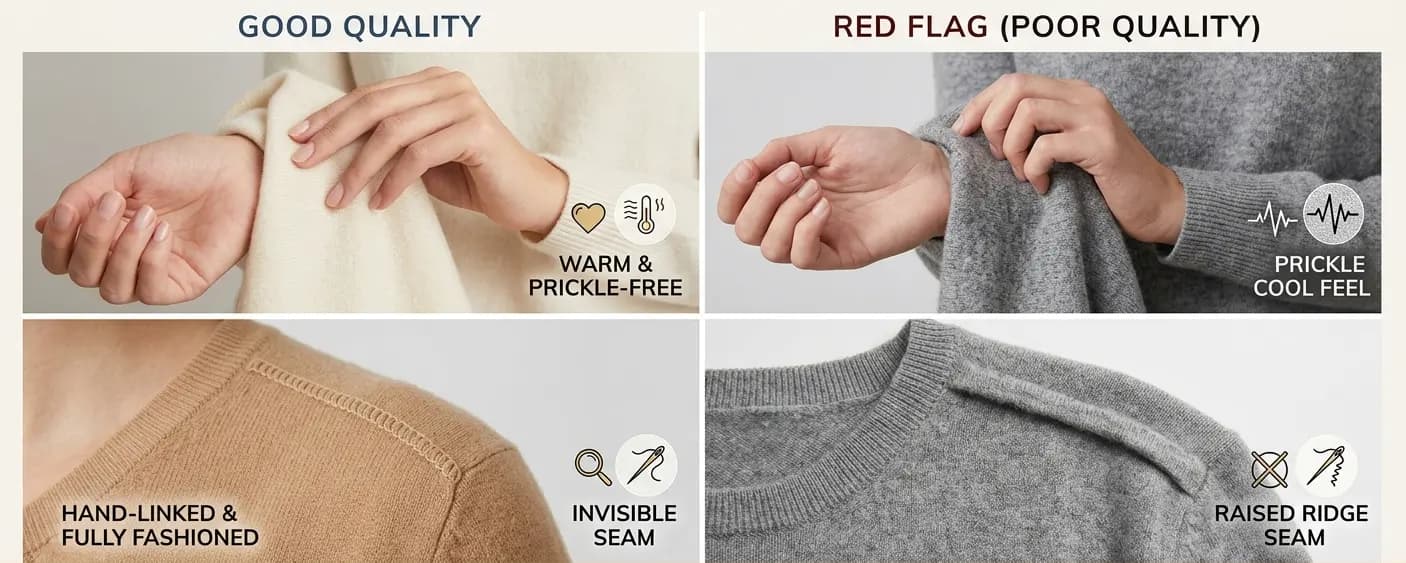
1) The Wrist Test: Softness and Prickle
Hold the fabric against the inside of your wrist for 3-5 seconds.
Pass signal:
- Warm, soft, and prickle-free
- No synthetic slickness
Red flag:
- Prickle, roughness, or cool synthetic feel
2) The Drape Test: Fabric Behaviour
Let part of the garment fall naturally, then gently bunch and release.
Pass signal:
- Fluid fall
- Smooth recovery
- No sharp creasing
Red flag:
- Stiff drop
- Sharp spring-back
- Crease retention suggesting non-cashmere blend behaviour
3) The Density Test: Yarn and Ply Quality
Hold the knit against light and test compression between fingers.
Pass signal:
- Semi-opaque at standard 2-ply weight
- Light spring and recovery under gentle squeeze
Red flag:
- Excess transparency for claimed weight
- Flat, lifeless compression response
Reading the Label: Four Mandatory Checks
4) Fibre Composition
Look for regulated composition language.
Pass signal:
- "100% Cashmere" or clearly stated blend percentages
Red flag:
- Vague, non-regulated naming used as substitute for composition clarity
5) Grade or Micron Transparency
Check if the brand states grade or micron detail.
Pass signal:
- Grade A or specific micron reference
Red flag:
- Only marketing superlatives with no measurable spec
6) Origin and Manufacturing Detail
Read country of manufacture and any mill or partner information.
Pass signal:
- Clear, specific manufacturing detail
Red flag:
- Premium pricing with minimal manufacturing transparency
7) Care Label Consistency
Check whether care instructions match true cashmere handling.
Pass signal:
- Gentle care instructions (cool wash/hand wash and flat dry guidance)
Red flag:
- Instructions inconsistent with premium cashmere handling expectations
Construction Quality: Three Inspection Points
8) Fully Fashioned vs Cut-and-Sew
Inspect seams inside the garment.
Pass signal:
- Fully fashioned construction cues
- Clean, shaped panel joining
Red flag:
- Cut-and-sew construction on a premium-priced piece without clear justification
9) Linking Quality at Seams
Check shoulder and joining seams from outside and inside.
Pass signal:
- Smooth, low-visibility seam finish
Red flag:
- Raised seam ridges and inconsistent seam execution
10) Finish Quality: Ribbing and Edges
Inspect cuffs, hem, and neckline.
Pass signal:
- Even rib structure
- Good recovery
- Flat, consistent finishing
Red flag:
- Baggy ribbing, uneven tension, curling or puckering edges
Brand Transparency: What Strong Brands Disclose
High-quality brands can explain:
- Fibre grade or micron range
- Manufacturing location and process detail
- Supply chain standards or certification context
- Clear returns policy
Transparency red flags:
- Grade cannot be provided when asked
- Heavy claim language without data
- Sustainability claims without evidence
Online Buying Protocol
When you cannot touch the garment, assess information quality.
Look for these seven items:
- Fibre composition
- Grade or micron detail
- Ply specification
- Garment weight
- Manufacturing location
- Care instructions
- Clear returns policy
If several are missing, treat it as an information risk.
Quick 10-Point Checklist
| # | Check | Pass signal | Flag signal |
|---|---|---|---|
| 1 | Wrist test | Warm, soft, no prickle | Prickle/cool synthetic feel |
| 2 | Drape test | Fluid fall and recovery | Stiff fall or sharp spring |
| 3 | Density test | Semi-opaque and springy | Too transparent or flat |
| 4 | Composition | Clear regulated composition | Vague naming only |
| 5 | Grade/micron | Specific quality metric | No measurable quality detail |
| 6 | Origin/making | Clear manufacturing detail | Premium price, low detail |
| 7 | Care consistency | Care aligns with fibre | Care claim mismatch |
| 8 | Construction | Fully fashioned quality signs | Cheap cut-and-sew feel |
| 9 | Linking | Smooth, low-visibility seams | Raised ridge seams |
| 10 | Finish | Even ribbing and recovery | Early loss of structure |
Frequently Asked Questions
What is the most reliable in-store check?
Use the wrist test plus composition and grade information together.
Can I trust "100% cashmere" labels?
They are regulated claims, but quality still varies by grade and construction.
Does weight tell me anything useful?
Yes. Weight is a practical consistency check against claimed ply and garment category.
Is online buying still safe?
Yes, if the product page provides complete quality information and a clear returns process.
Is pilling always a bad sign?
No. Early pilling can be normal. Persistent heavy pilling after early wear is a stronger quality warning.