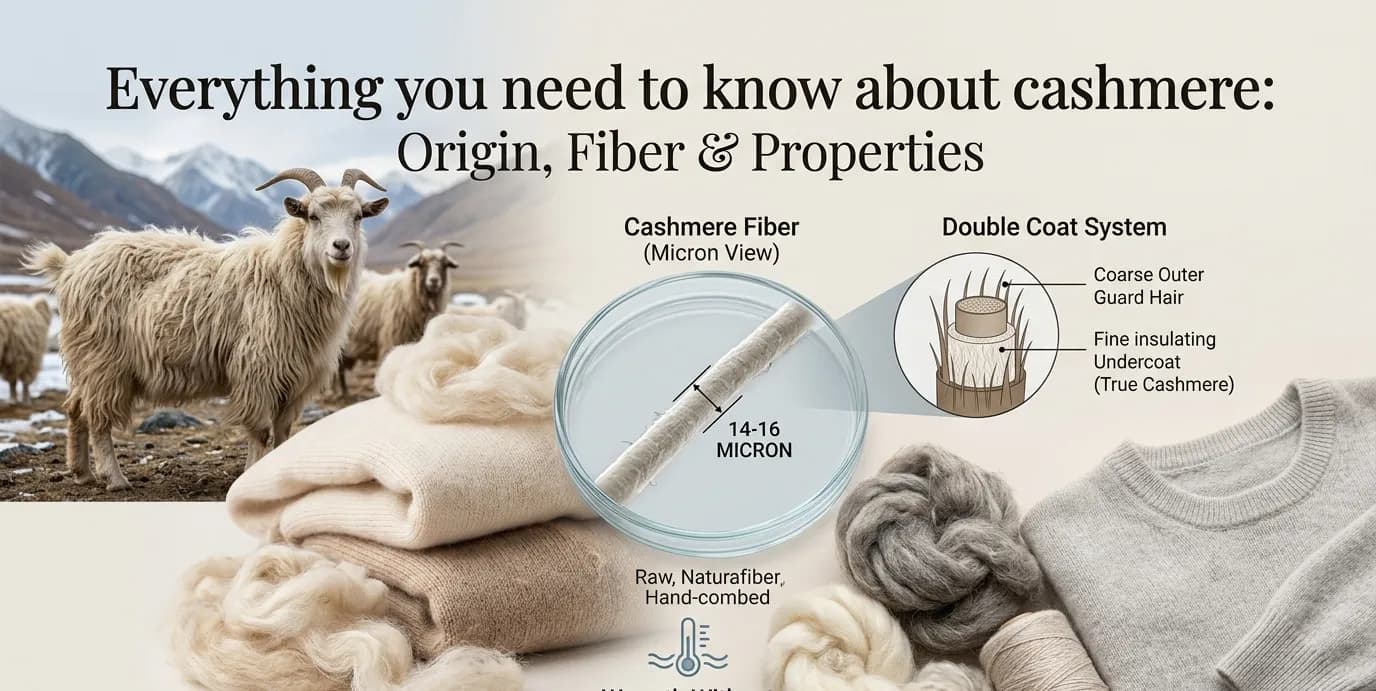
What Is Cashmere? Origin, Fiber & Properties
Learn what cashmere is, where it comes from, and how fiber structure affects softness, warmth, drape, and long-term wear.
Everything You Need to Know About Cashmere
What Is Cashmere?
Cashmere is the fine insulating undercoat grown by certain goats to protect themselves from severe winter cold. Once collected, cleaned, and spun, that underfibre becomes one of the world's most prized luxury materials: soft, light, warm, and exceptionally comfortable against the skin.
That is why cashmere feels different the moment you touch it. It is lighter than it looks, warmer than its thickness suggests, and softer than most wool because the fiber itself is finer, more flexible, and better at trapping air.
This guide explains what cashmere actually is: the goat that produces it, the double-coat system that makes it possible, the anatomy of the fiber, and the physical properties that matter when you wear it.
The Cashmere Goat: The Animal Behind the Fiber
Cashmere comes from domesticated goats (Capra hircus) that grow a fine, soft undercoat beneath a coarser outer layer. "Cashmere goat" is not one single standardized breed. It is a functional term for goats that produce enough fine underfleece, usually under 19 microns in diameter, to be commercially valuable.
These goats are adapted to harsh, dry, windy climates with severe winters. In those conditions, survival depends on growing an undercoat that insulates efficiently without heavy weight.
Well-known producing regions include Mongolia, China, Ladakh, Afghanistan, Iran, and wider Central Asia. Origin matters, but origin alone does not define quality. Genetics, age, nutrition, climate, and processing all influence the final result.
The Double Coat: Why Cashmere Exists
A cashmere goat grows two coats:
- Outer coat: coarse guard hairs for weather protection
- Undercoat: fine, downy fiber that becomes cashmere
The undercoat typically sits around 14 to 19 microns in quality animals. The valuable underfiber must be separated from coarse guard hair in dehairing, one major reason quality cashmere is costly.
Seasonal Growth: Why Winter Shapes Quality
Cashmere growth is driven by shortening daylight and falling temperatures. As winter deepens, undercoat follicles become more active.
Severe climates often produce finer, more insulating fiber because the goat is adapting for survival, not luxury. The same biology that helps the animal survive is what gives cashmere its premium feel.
Combing vs Shearing
Cashmere is collected in spring when undercoat naturally loosens.
- Hand-combing: usually cleaner raw fiber, often less guard-hair contamination
- Shearing: faster collection, but greater mixing of coarse and fine fibers
"Hand-combed" can be a meaningful quality signal, but the finished fiber standard still matters most.
The Cashmere Fiber: Structure, Microns, and Performance
Cashmere is a protein fiber made mainly of keratin. Its structure explains its softness, elasticity, and warmth.
Keratin and Elasticity
Keratin structures in cashmere flex and recover like tiny springs. This is why good cashmere can recover well from ordinary folding and wear.
It also explains care sensitivity: high heat, rough agitation, and harsh detergent can damage keratin and reduce softness and shape recovery.
Scale Structure and Softness
Cashmere has fine cuticle scales. Compared with coarser wool, those scales are less pronounced, which reduces scratchiness and improves smoothness against skin.
Crimp: The Architecture of Warmth
Natural crimp creates tiny air pockets in yarn and fabric. Trapped still air is the main source of insulation, which is why cashmere feels warm without bulk.
Micron Count: The Most Important Number
Fiber diameter is measured in microns (one thousandth of a millimeter). Human hair is often around 60 to 80 microns. Fine cashmere is usually around 14 to 15.5 microns.
As a practical guide:
| Grade | Typical Micron Range | Practical Feel |
|---|---|---|
| Grade A | 14 to 15.5 um | Very soft, refined, premium |
| Grade B | 15.5 to 18 um | Soft with more texture |
| Grade C | 18 to 19+ um | Less luxurious, more ordinary hand-feel |
Micron count is usually more meaningful than marketing language.
What This Means in Real Wear
1. Warmth Without Weight
Cashmere offers excellent warmth-to-weight. Lightweight knits can feel very warm without looking bulky.
2. Moisture Management and Breathability
Cashmere is hygroscopic. It can absorb and release moisture vapor without feeling wet as quickly as many synthetics.
3. Temperature Regulation
Because it combines insulation and breathability, cashmere works across changing indoor-outdoor conditions.
4. Elasticity and Shape Recovery
Good cashmere can recover from daily wear if cared for correctly. It should be stored folded and dried flat after washing.
5. Drape and Lustre
Fine fibers create fluid drape and a subtle natural lustre distinct from synthetic shine.
6. Potential to Improve with Care
High-quality cashmere can become softer over time with careful washing, flat drying, and gentle de-pilling.
Cashmere vs Other Fibers (Quick Positioning)
Compared with standard wool, cashmere is usually finer, softer, warmer by weight, and scarcer. Fine merino comes closest in comfort, but cashmere often leads in luxury hand-feel and warmth efficiency.
Compared with alpaca, cashmere often offers a softer top-end drape, while alpaca can provide strong value in other categories.
Compared with silk, cashmere serves a different purpose: silk prioritizes sheen and smoothness, while cashmere prioritizes insulation and softness.
How to Buy Better Using Fiber Science
Fiber Diameter Matters More Than Price Alone
Price can include branding and retail markup. Micron quality predicts feel and long-term satisfaction more reliably.
Separate Grade from Ply
- Grade = fiber fineness and quality
- Ply = yarn construction and thickness
A thick knit made from mediocre fiber is not automatically better than a lighter knit made from excellent fiber.
Trust Your Hand
If data is unavailable, test softness on sensitive skin areas (inner wrist or neck). Good cashmere should feel smooth, even, and non-scratchy.
Expect Natural Variation
Cashmere is biological, not synthetic. Year-to-year variation exists, and strong producers control this through better selection and blending.
Frequently Asked Questions
What is cashmere exactly?
Cashmere is the fine undercoat fiber from certain goats, processed into luxury yarn and fabric.
What kind of goat produces cashmere?
Goats in the species Capra hircus that produce commercially useful fine underfleece.
Why is cashmere so soft?
Because the fibers are very fine and have a smoother, less prickly scale profile than coarse wool.
Why is cashmere warmer than it looks?
Natural crimp traps still air, giving strong insulation with low weight.
Is pashmina different from cashmere?
Pashmina generally refers to exceptionally fine cashmere, traditionally associated with Changthangi goats and Kashmiri craft.
Why is cashmere more expensive than wool?
Supply is low and processing is labor-intensive, especially dehairing and quality control.
Does cashmere improve with age?
Good cashmere often does, if washed gently, dried flat, stored properly, and de-pilled carefully.
What damages cashmere most?
Heat, harsh detergent, aggressive agitation, tumble drying, and prolonged hanging.
Understanding the Material Helps You Buy Better
Once you understand cashmere as a cold-climate underfiber shaped by micron count, crimp, keratin structure, and processing quality, buying decisions become clearer and more objective.
The next step is grading: once you know what cashmere is, the logical next question is how to judge quality.