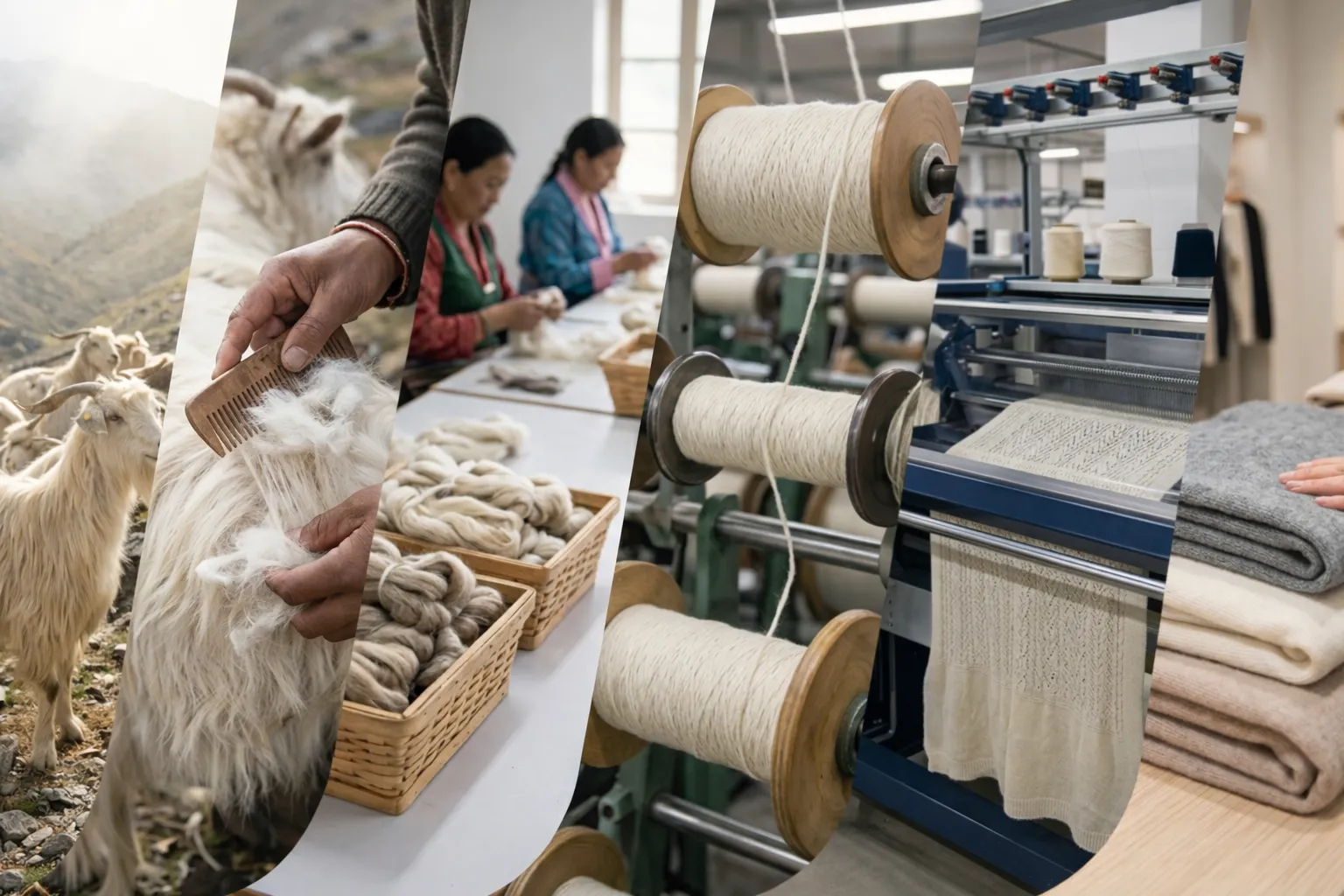
How Cashmere Is Made: From Goat to Garment Explained
Discover how cashmere is made from hand combing and fibre sorting to spinning, knitting, and finishing. Learn what affects quality at every stage.
How Cashmere Is Made: From Goat to Garment Explained
The Journey No Label Tells You About
A cashmere label might say "100% cashmere" and "Made in X," but it rarely explains the long supply chain and technical processing behind true quality.
Understanding production is the fastest way to understand why one garment lasts decades while another pills early and loses shape. Quality is decided step by step, from spring combing to final inspection.
The Cashmere Supply Chain: A Global Journey
Cashmere production is unusually global. Raw fibre is collected in one region, processed in another, spun elsewhere, and assembled in a different country.
| Stage | Where it happens | Typical specialists |
|---|---|---|
| Combing | Mongolia, China, Afghanistan, Iran, Ladakh | Herders and pastoralists |
| Sorting/Grading | Local markets and hubs | Traders, graders, sourcing agents |
| Dehairing | China, Italy | Specialist mill operators |
| Scouring/Dyeing | China, Italy, Scotland | Processing mills and dye houses |
| Spinning | China, Italy, Scotland, Japan | Spinning mills |
| Knitting/Weaving | China, Italy, Scotland, UK, Bangladesh, Romania | Factories and heritage mills |
| Linking/Finishing | Italy, Scotland, UK | Linking operators, finishing technicians |
| QC/Distribution | Throughout chain | QC teams, brand logistics |
Step 1: Spring Combing (March to May)
Cashmere goats naturally shed winter undercoat in spring. Timing is critical: too early and undercoat is not ready; too late and fine fibre is lost.
Hand Combing
- Common in Mongolia, Afghanistan, and Ladakh
- Fine comb removes soft undercoat while leaving coarse guard hair
- Around 20 to 30 minutes per goat
- Roughly 100 to 250 grams fibre yield per goat
Shearing
- Faster (around 3 to 5 minutes per goat)
- Collects undercoat and guard hair together
- Requires heavier downstream separation
- Usually lower starting fibre quality
Step 2: Sorting, Grading, and First Sale
Raw fibre is aggregated and sorted by:
- Colour (white often valued highest for dye flexibility)
- Fineness (touch and lab verification)
- Length
- Cleanliness and contamination level
Lab tests then confirm diameter and pricing bands.
Step 3: Dehairing
Dehairing separates valuable fine undercoat from coarse guard hairs (kemp). This is one of the most critical quality points in the chain.
Poor dehairing leads to:
- Scratchier hand-feel
- More aggressive pilling
- Uneven yarn behavior
Good dehairing leads to:
- Cleaner, softer yarn input
- Better spinning consistency
- Better long-term wear performance
Step 4: Scouring (Washing Raw Fibre)
After dehairing, fibre is scoured to remove oils, dirt, and residues.
Step 5: Dyeing
Cashmere can be dyed at different stages:
- Stock dyeing (loose fibre): typically deepest and most even colour
- Top dyeing (sliver stage): strong consistency, slightly less depth
- Yarn dyeing: useful but less penetrative than stock dyeing
- Piece dyeing (finished fabric): lowest-cost path, often less depth and fastness
Dye stage choice strongly influences colour richness and fade behavior.
Step 6: Carding and Combing
This stage prepares fibre for spinning by opening, aligning, and refining fibre flow.
- Carding: opens and blends fibres
- Combing: aligns fibres and removes shorter fractions (in worsted-style preparation)
Better preparation usually means smoother yarn and improved pilling resistance.
Step 7: Spinning
Spinning draws fibre into continuous yarn and adds twist for cohesion.
Key variables:
- Twist level
- Yarn count consistency
- Spinning method (ring spinning is common in premium production)
Ply construction begins after singles are formed.
Step 8: Knitting or Weaving
Cashmere garments are made by either:
- Knitting: sweaters, cardigans, scarves, accessories
- Weaving: coats, structured fabrics, tailored pieces
Fully Fashioned Knitting vs Cut-and-Sew
Fully fashioned construction shapes panels during knitting, then links them with flatter seams. Cut-and-sew cuts from knitted fabric and seams with bulkier construction.
Fully fashioned is usually a stronger quality signal.
Step 9: Linking and Seaming
Linking joins knitted panels loop by loop for flat, refined seams.
- Hand linking: premium precision, labour intensive
- Semi-automatic linking: faster, still skill dependent
This stage has major impact on seam comfort, durability, and finish quality.
Step 10: Finishing
Finishing defines final hand-feel and look:
- Controlled milling/raising
- Surface refinement
- Steam setting and shape correction
Finishing quality often separates premium garments from average ones.
Step 11: Quality Control
Premium production uses multi-stage QC, not just final inspection.
Common gates include:
- Raw fibre testing (diameter, kemp, length)
- Yarn evenness and strength checks
- Fabric defect inspection
- 100% finished garment measurement and surface check
Budget chains often rely on limited end-of-line sampling.
Step 12: Labelling, Packaging, and Distribution
Final labels are legally compliant but often incomplete in quality detail. Country of manufacture does not always indicate fibre origin.
Premium vs Budget Production at a Glance
| Step | Premium approach | Budget approach | Impact |
|---|---|---|---|
| Combing | Hand-combed, source sorted | Faster bulk collection | Raw fibre consistency |
| Dehairing | Multi-pass precision | Lower-effort separation | Softness, pilling |
| Dyeing | Early-stage dyeing | Late-stage lower-cost dyeing | Colour depth and fastness |
| Spinning | Controlled, even yarn | Wider tolerance output | Yarn behavior |
| Construction | Fully fashioned + linking | More cut-and-sew | Fit, seam quality |
| QC | In-process + final checks | Mostly end-line checks | Defect consistency |
Frequently Asked Questions
How long does a cashmere sweater take to produce?
From spring combing to finished garment, usually 6 to 12 months across global supply chains.
Where is most cashmere made?
Raw fibre mostly comes from Mongolia and China. Processing and garment manufacturing are distributed across China, Italy, Scotland, the UK, and other regions.
What does "fully fashioned" mean?
Panels are knitted to shape and linked loop by loop, rather than cut from fabric. This usually means better structure and seam quality.
Does "Made in Scotland" mean Scottish fibre?
No. It means final manufacturing happened in Scotland. Raw fibre is imported.
Is knitted cashmere different from woven cashmere?
Yes. Knitted cashmere stretches and feels softer in casual garments. Woven cashmere is more stable and structured, often used in coats and tailoring.
Why is hand-combed cashmere more expensive?
It is slower, cleaner, and produces better raw fibre with less guard-hair contamination.
Final Takeaway
Cashmere quality is cumulative. Every production decision adds or removes value: combing method, dehairing precision, dye stage, spinning control, construction technique, finishing quality, and QC discipline.
Once you understand the chain, labels become easier to interpret and buying decisions become much more confident.