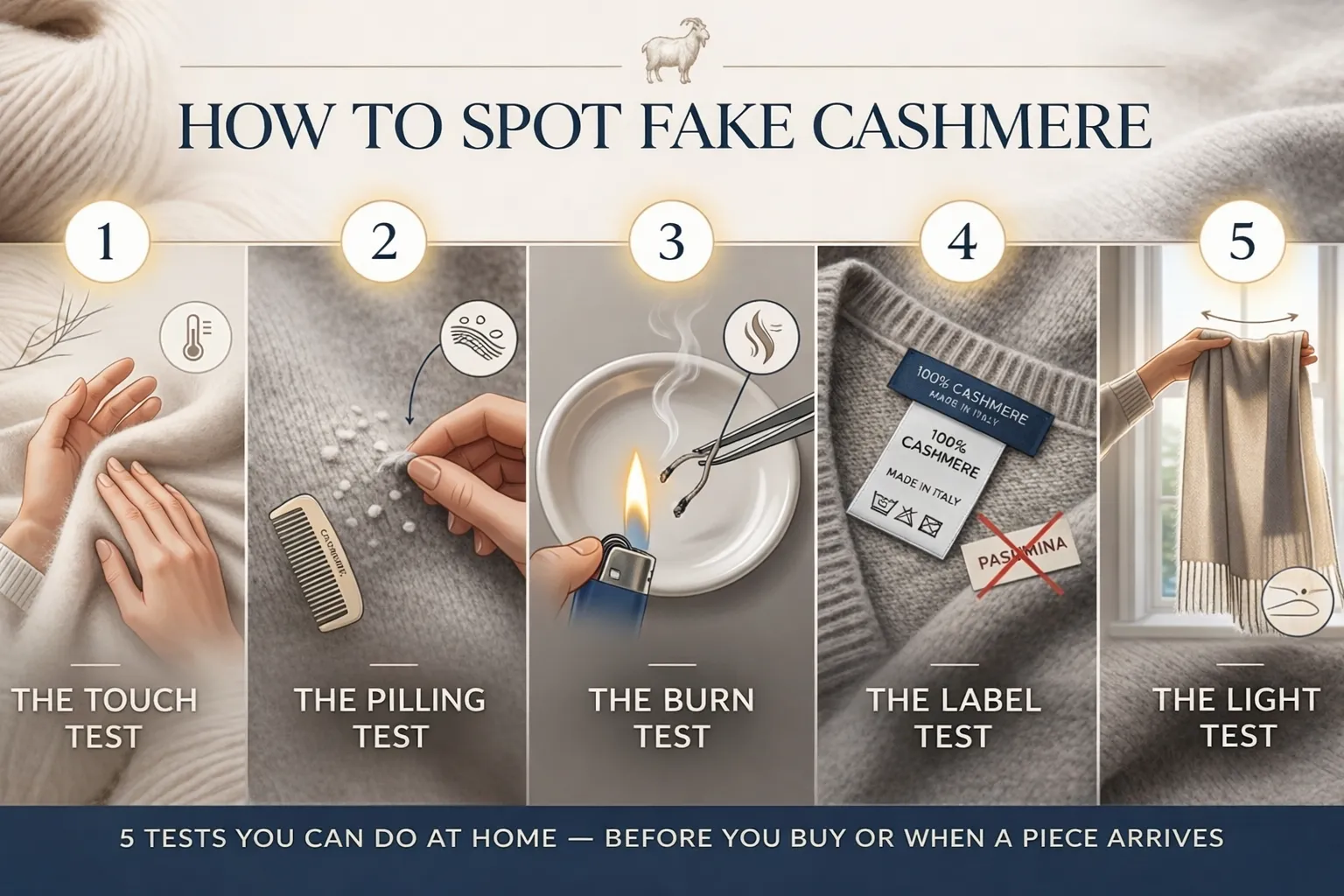
How to Spot Fake Cashmere: 5 Simple Tests to Check Authenticity
Learn how to identify real vs fake cashmere with 5 easy at-home tests. Discover touch, burn, pilling, label, and light checks before you buy.
How to Spot Fake Cashmere: 5 Tests You Can Do at Home
Genuine cashmere is one of the most counterfeited fabrics in the world. These five practical tests help you verify authenticity in under 10 minutes, without specialist equipment.
If you are buying cashmere in-store or online, the risk is not only obvious knockoffs. Mislabeling, low-grade blends, and recycled fiber sold as new are all common. No single test is perfect by itself, but two or three consistent results usually give a reliable answer.
Why Fake Cashmere Is Common
Cashmere is naturally scarce. A cashmere goat yields only about 150 to 200 grams of usable fiber each year. That supply pressure creates strong incentives to dilute, blend, or misrepresent products.
The most common fake categories are:
- Blended cashmere: mixed with wool, acrylic, or other fibers.
- Recycled cashmere sold as new: shorter, weaker fibers.
- Synthetic substitutes: marketed with vague language like "cashmere touch".
Price helps, but it is not enough. Very low price is a warning. High price is not proof.
Before You Test
- Run at least 3 tests before deciding.
- Trust pattern consistency, not one result.
- Read legal care labels, not just marketing hang tags.
Test 1: The Touch Test
Real cashmere fibers are very fine (often around 14 to 19 microns), which gives a soft, light, warm hand-feel.
How to do it
- Press fabric between your palms without rubbing.
- Rub gently between thumb and forefinger for 10 to 15 seconds.
- Hold against inner wrist or forearm for sensitivity check.
What to look for
| Real cashmere signals | Likely fake/blended signals |
|---|---|
| Soft and light immediately | Coarse or unnaturally slippery feel |
| Low static buildup | Fast static cling after rubbing |
| No itch on sensitive skin | Noticeable itch or scratch |
| Warm for its weight | Heavier feel for same warmth |
Test 2: The Pilling Test
Pilling itself is not proof of fake cashmere. Quality cashmere can pill lightly in early wears, especially at friction points.
How to do it
- Choose a hidden area (inside hem or seam).
- Rub fabric against itself for 20 to 30 seconds.
- Check if pills are loose or deeply anchored.
- Remove one pill gently and inspect fabric underneath.
What to look for
| Real cashmere signals | Likely fake/blended signals |
|---|---|
| Minor, surface-level pilling | Heavy pilling almost immediately |
| Pills remove cleanly | Pills are anchored and tear surface |
| Knit remains intact | Knit weakens quickly |
| Some pilling early is normal | "Never pills" claim may indicate synthetic content |
Test 3: The Burn Test
This is the most chemically decisive home test when done carefully on a tiny hidden sample.
How to do it
- Pull 2 to 3 loose threads from an inside seam.
- Hold with metal tweezers over ceramic or metal surface.
- Bring flame to thread edge for 2 to 3 seconds.
- Observe smell, burn behavior, and residue.
What to look for
| Real cashmere (protein fiber) | Synthetic fiber |
|---|---|
| Burns slowly, may self-extinguish | Burns fast, often keeps burning |
| Smells like burning hair | Chemical/plastic smell |
| Leaves crushable ash | Leaves hard bead/residue |
| No dripping plastic melt | May bubble or drip |
Test 4: The Label Test
Label reading is your fastest pre-buy filter.
What to check
- Exact fiber percentages (
100% cashmere,90% cashmere, 10% silk, etc.) - Regulated fiber names (
cashmere,wool,acrylic,silk) - Care instructions consistent with cashmere (cold hand wash or dry clean)
- Country of manufacture vs fiber origin claims
Label interpretation table
| Label text | What it usually means | Verdict |
|---|---|---|
| 100% Cashmere | Best case (still verify quality) | Good |
| 90% Cashmere, 10% Silk | Legitimate blend | Good |
| 80% Cashmere, 20% Merino | Real blend, not pure | Acceptable |
| Cashmere-like / Cashmere touch | Marketing phrase, not legal fiber claim | Red flag |
| Pashmina (alone) | Not a regulated fiber-content term | Red flag |
Test 5: The Light Test
Backlighting reveals knit quality and fiber character.
How to do it
- Hold garment toward bright window or lamp.
- Check knit structure and uniformity.
- Look for a subtle fine-fiber halo.
- Stretch gently and release to test recovery.
What to look for
| Real cashmere signals | Likely fake/blended signals |
|---|---|
| Slight natural variation in knit | Overly uniform, machine-perfect texture |
| Subtle fine halo | Flat synthetic sheen or heavy fuzz |
| Good elastic rebound | Distorts or stays stretched |
| Full knit junctions | Thin, transparent junction points |
Additional Signals That Help
- Weight vs warmth: cashmere should feel lighter than expected.
- Drape: real cashmere falls softly, not rigidly.
- Sound: synthetics often rustle more when crumpled.
- Rebound: quality cashmere springs back quickly.
- Finishing: poor seams often correlate with poor fiber quality.
Quick Reference: All Tests at a Glance
| Test | Fast check |
|---|---|
| Touch | Soft, warm, minimal static, no itch |
| Pilling | Minor loose pills are normal; anchored heavy pilling is not |
| Burn | Hair smell + crushable ash, no hard bead |
| Label | Specific percentages, regulated terms, realistic care instructions |
| Light | Subtle variation, gentle halo, strong rebound |
Final Verdict
Use these five tests together, not in isolation. If three or more tests align, your confidence level is high.
With practice, you will start identifying real cashmere quickly by hand-feel, drape, and behavior alone.
For next steps, compare fiber behavior in Cashmere vs Merino and learn care basics in Cashmere Care.