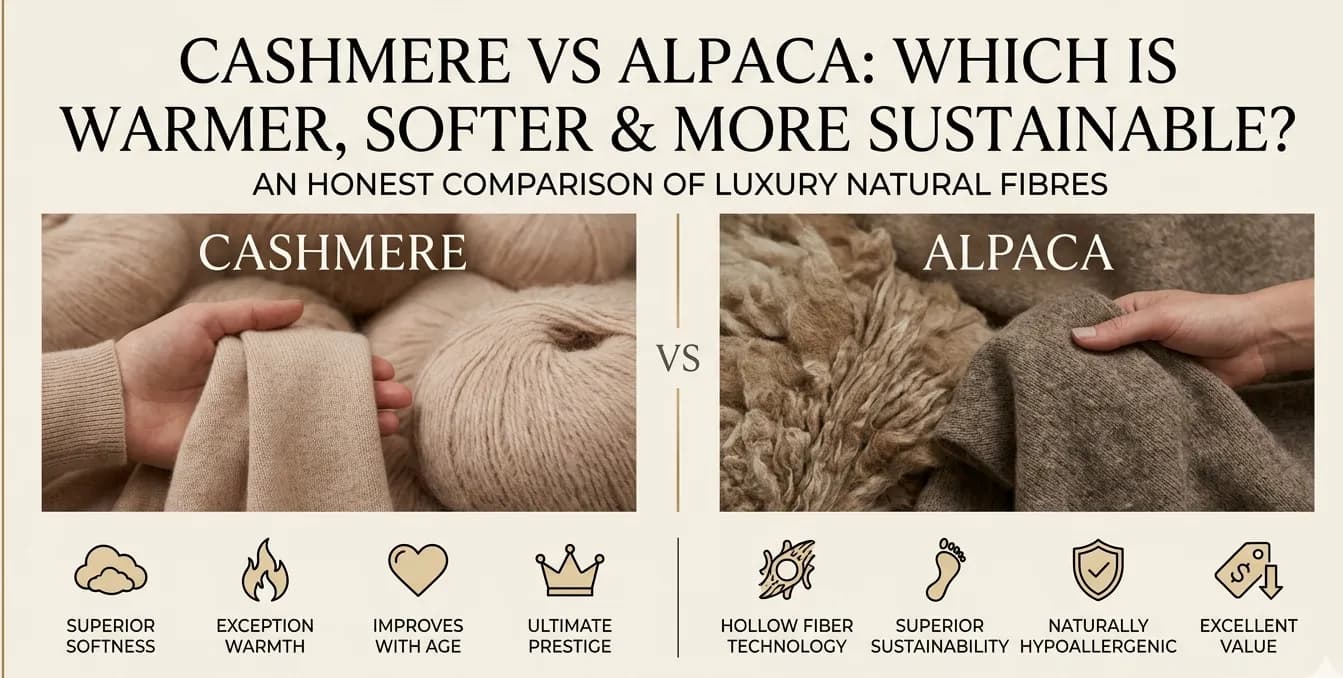
Cashmere vs Alpaca: Which Is Warmer, Softer & More Sustainable?
Discover the key differences between cashmere and alpaca. Compare warmth, softness, durability, sustainability, and value to choose the right luxury fibre for you.
Cashmere vs Alpaca
Which Is Softer and Warmer?
Cashmere and alpaca are two of the most important luxury natural fibres in modern knitwear. They are often treated as interchangeable, but they behave differently in comfort, warmth, ageing, care, and value.
This guide compares them across the factors that matter most in real buying decisions: softness, warmth, hypoallergenic suitability, durability, sustainability, care, and long-term value.
Two Premium Fibres: Similar on Paper, Different in Wear
Both fibres come from high-altitude animals in demanding climates. Both can be very fine. Both offer excellent warmth-to-weight compared with standard wool.
Where they differ is in structure and wearing character. Cashmere is known for ultra-fine softness and a plush hand feel. Alpaca is known for thermal efficiency, lower lanolin reactivity, and stronger raw durability.
Fibre Biology: Origin and Structure
Alpaca
Alpaca fibre comes from the alpaca (Vicugna pacos), a South American camelid domesticated in the Andes. Most global production remains concentrated in Peru, with additional production in Bolivia, Chile, and smaller international farms.
The two commercial breeds are:
- Huacaya: fluffy, crimped fleece; most common in knitwear
- Suri: longer, silkier, lower-crimp fibre; rarer and more draped
Alpaca yield per animal is far higher than cashmere yield per goat, which is one reason alpaca is generally less expensive than equivalent-grade cashmere.
Cashmere
Cashmere comes from the fine undercoat of cashmere goats. Usable annual yield per goat is relatively low, and processing is intensive. This supply constraint is a major reason premium cashmere costs more.
Structural difference that matters
Many alpaca fibres are partially hollow (medullated), which improves thermal efficiency at the same garment weight. Cashmere fibres are solid and rely primarily on air trapped between fibres in yarn and knit structure.
Softness: Grade Matters More Than Marketing
Softness depends on micron grade, not label language.
| Fibre grade | Typical micron range | Softness profile |
|---|---|---|
| Grade A Cashmere | ~14-15.5 um | Exceptionally soft, plush, skin-comfort first |
| Baby Alpaca | ~19-23 um | Very soft, cleaner/crisper hand feel |
| Super Fine Alpaca | ~23-26 um | Soft but more texture for sensitive skin |
| Coarser Alpaca Grades | 26 um+ | Noticeably more textured |
At the top end, Grade A cashmere is typically softer than baby alpaca. Baby alpaca remains genuinely luxurious, but the hand feel is usually a little cleaner and less plush than fine cashmere.
Warmth-to-Weight: Alpaca's Strongest Advantage
At comparable fabric weights, alpaca often feels warmer, largely due to its fibre structure.
In practice:
- A lightweight alpaca scarf often feels warmer than an equal-weight cashmere scarf
- Cashmere still performs extremely well, but alpaca usually has the thermal edge per gram
If maximum warmth at minimum weight is your main criterion, alpaca is usually the stronger choice.
Hypoallergenic and Sensitivity Considerations
"Hypoallergenic" claims are often oversimplified.
- Alpaca is naturally lanolin-free, so it is often a better option for people sensitive to lanolin.
- Cashmere can still be comfortable for many sensitive wearers if fibre diameter is fine enough.
- Mechanical prickle is usually caused by coarser fibre, not by true allergy.
For confirmed lanolin sensitivity, baby alpaca is generally the safer premium-fibre choice.
Care Requirements
Both fibres need similar care discipline:
- Cool water
- Gentle detergent for wool/cashmere fibres
- Minimal agitation
- Flat drying
Alpaca can be slightly more resistant to felting pressure than cashmere, but both can be damaged by heat, friction, and aggressive spin.
Durability and Ageing
Alpaca fibre is generally stronger per diameter and often pills less in early wear.
Cashmere has a different long-term character: quality cashmere often improves in feel after early wear-in and maintenance, while alpaca tends to stay more consistent over time.
Practical takeaway:
- Alpaca: stronger raw durability and lower pilling tendency
- Cashmere: superior refinement potential when high grade and well maintained
Sustainability and Ethics
Across common production models, alpaca often performs better environmentally.
Key reasons:
- Lower pasture damage profile compared with goat overgrazing patterns
- Stronger integration with traditional Andean production communities
- Better baseline land-impact profile in many supply chains
Certified cashmere can narrow the gap, but alpaca usually retains an advantage in mainstream sustainability comparisons.
Price and Value
At comparable quality tiers, baby alpaca usually costs less than Grade A cashmere.
For many buyers, alpaca provides:
- Strong warmth
- High comfort
- Better sustainability profile
- Better value-per-pound
Grade A cashmere remains the premium softness benchmark and often justifies higher pricing for buyers prioritising touch and luxury recognition.
Master Comparison Table
| Dimension | Grade A Cashmere | Baby Alpaca | Practical edge |
|---|---|---|---|
| Softness | Exceptional | Very soft | Cashmere |
| Warmth-to-weight | Excellent | Excellent+ | Alpaca |
| Lanolin-free suitability | Partial | Yes | Alpaca |
| Early pilling tendency | Moderate | Lower | Alpaca |
| Long-term ageing character | Often improves with care | More stable/consistent | Cashmere for refinement, alpaca for consistency |
| Durability under abrasion | Good | Very good | Alpaca |
| Sustainability baseline | Mixed/depends on sourcing | Generally stronger | Alpaca |
| Typical price at premium tier | Higher | Lower | Alpaca |
| Luxury recognition | Highest | Growing | Cashmere |
Verdict: Which One Should You Choose?
Choose cashmere if your top priority is maximum softness, refined hand feel, and classic luxury positioning.
Choose baby alpaca if your priority is warmth efficiency, lower lanolin reactivity, stronger sustainability credentials, and better value.
For many wardrobes, the best result is mixed use: cashmere for softness-led pieces, alpaca for warmth-led layers and accessories.
Frequently Asked Questions
Is baby alpaca softer than cashmere?
Usually no when compared with Grade A cashmere. Baby alpaca is very soft, but fine cashmere is typically softer in direct side-by-side wear.
Is alpaca warmer than cashmere?
At equal garment weight, alpaca is often warmer.
Is alpaca better for wool sensitivity?
For lanolin-sensitive users, alpaca is usually the safer option because it is naturally lanolin-free.
Does alpaca pill less than cashmere?
Often yes, especially in early wear.
Which is better for scarves?
For maximum warmth, alpaca often wins. For softness-first feel, cashmere is usually preferred.